Platform · API & Integrations

Wire your stack
to your
shipments.

A REST API, webhooks, EDI, and a set of pre-built connectors for the storefronts, ERPs and accounting tools our clients actually use. Where a connector doesn't exist, you get a webhook from the same API surface — not a feature request.

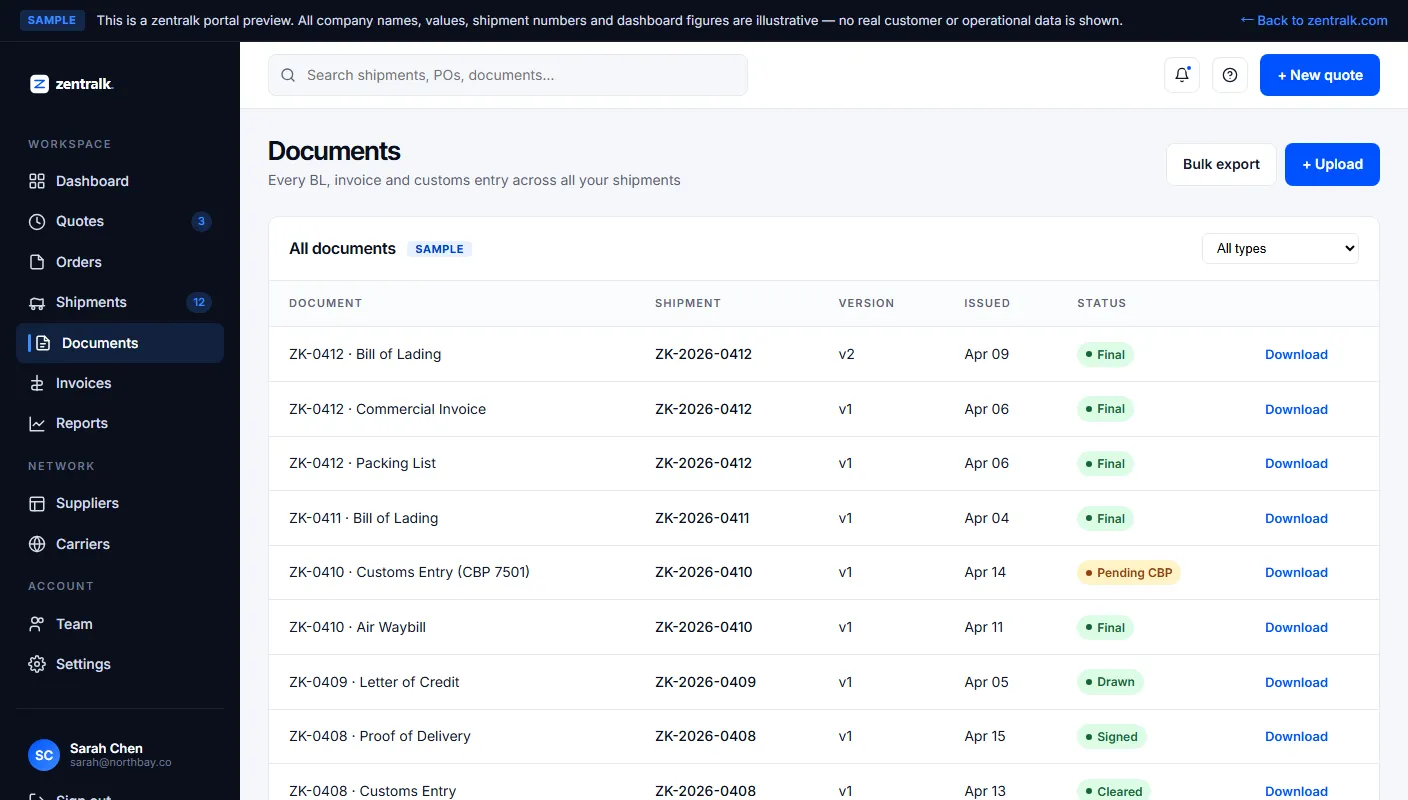
zentralk API and integrations panel
Pre-built connectors

The stacks we
plug into on day one.

Every connector below is live in production — not a roadmap tile. Setup is OAuth where the platform supports it, or an API-key swap where it doesn't. Most tenants connect their first system inside the walkthrough call.

Shopify · Shopify Plus

Two-way: inventory sync on write, order drop on fulfill, tracking write-back on tender. B2B and retail catalogs both supported. Multi-location matches our pooled-stock allocation engine so Shopify sees one inventory number across all nine warehouses.

WooCommerce

REST API v3 integration via application passwords. Orders, inventory, tracking and refund flows. Works cleanly on multi-site WordPress, with per-site tenant scoping for agencies running client stacks.

BigCommerce · Magento 2

BigCommerce via V3 REST + webhooks; Magento 2 via REST/GraphQL. Both carry the same allocation-rule engine as Shopify — route-to-warehouse, split-ship and virtual-stock bundles supported out of the box.

Amazon Seller Central · Vendor Central

Seller Central via SP-API: orders, inventory, MCF passthrough, FBA inbound plan creation. Vendor Central via EDI (see below). Amazon Multi-Channel Fulfillment and Logistics Plus both handled at the tenant level.

Walmart Marketplace · TikTok Shop

Walmart via Marketplace API v3 with routing-guide compliance built in; TikTok Shop via partner API. Both respect our retailer-EDI SLA so ASN and invoice events route where they need to.

NetSuite

SuiteScript + REST integration. PO sync from NetSuite into the orders module, receipt and inventory posting back, outbound shipment and invoice posting. Bundled on SuiteApp-certified install path for SuiteCloud customers.

QuickBooks · Xero · Sage Intacct

Freight invoices posted directly to AP; PO sync and payment remittance two-way. QBO via Intuit API; Xero via OAuth 2.0; Sage Intacct via web services. Line-item posting with class and department tagging preserved.

Microsoft Dynamics 365 · SAP · Oracle

Dynamics 365 F&SCM via Data Management Framework. SAP S/4HANA via IDoc and OData on request. Oracle NetSuite (above) and Oracle Fusion Cloud via REST. Enterprise integrations scoped per tenant during onboarding.

Slack · Microsoft Teams · Email

Exception alerts, shipment-status digests and inbound-document notifications routed to channels with per-team filters and quiet hours. Teams app is a native bot; Slack is a webhook + app-home configuration.

API surface

What the REST
API actually exposes.

The table below is the public contract: every resource, its principal fields, and the events it fires. The full OpenAPI 3.1 spec is provided on tenant onboarding; endpoints are versioned with a 12-month deprecation window on any breaking change.

Orders

/v1/orders · /v1/orders/{id} · /v1/orders/{id}/lines. CRUD on purchase orders with line-item sub-resource, revision history, and approval state transitions.

Events: order.created · order.acknowledged · order.line_updated · order.ready · order.booked · order.cancelled.

Shipments

/v1/shipments · /v1/shipments/{id} · /v1/shipments/{id}/containers · /v1/shipments/{id}/milestones. Full shipment record with containers, AWBs, and live milestone feed.

Events: shipment.booked · shipment.loaded · shipment.in_transit · shipment.milestone · shipment.exception · shipment.delivered.

Tracking events

/v1/tracking/{shipment_id} for polling · /v1/tracking/events (webhook stream) for push. Sources: carrier APIs, AIS, ADS-B, telematics. Event deduplication keyed by (shipment_id, event_code, timestamp).

Event throughput: burst 500 events/second per tenant; steady-state uncapped.

Documents

/v1/documents · /v1/documents/{id} · /v1/shipments/{id}/documents. Upload, download, and metadata on every BL, CI, PL, customs entry, and OGA filing. Version history exposed as a sub-resource.

Events: document.uploaded · document.version_added · document.signed · document.released.

Invoices

/v1/invoices · /v1/invoices/{id} · /v1/invoices/{id}/lines. Freight invoices with full line-item breakdown, linked source vendor invoice reference, and remittance status.

Events: invoice.issued · invoice.disputed · invoice.paid.

Quotes

/v1/quotes · /v1/quotes/{id}. Programmatic quote requests across ocean, air and truck, with service-level options and validity windows. Accept a quote to convert it into a shipment booking.

Events: quote.requested · quote.priced · quote.accepted · quote.expired.

Auth & tenancy

OAuth 2.0 authorization-code + refresh-token flow for user apps. API-key + HMAC-signed headers for server-to-server. Role-based access control inherited from the tenant's portal roles — the API never exceeds what a role's UI can do.

Rate limits: 600 req/min/tenant baseline; burst to 2,000 on signed contracts.

Webhooks

Subscribe per event type per resource. Payloads are HMAC-SHA256 signed; delivery guarantees are at-least-once with exponential backoff (1s → 5m over 24h). A dead-letter queue surfaces any event that ultimately fails delivery.

Replay: any event from the last 30 days is replayable via API; longer windows on request.

EDI

For the enterprise lanes where EDI is still the contract.

Retail distribution, vendor-managed-inventory programs, and 3PL passthrough runs on EDI — and the EDI desk still exists for a reason. Our EDI gateway speaks X12 (North America) and EDIFACT (Europe) over AS2 and VAN, with the document set below mapped to the same shipment record your REST clients read from.

Onboarding a trading partner typically takes 5–10 business days from first map to production — faster where you already have partner specs and a VAN mailbox. Every EDI event replays into the shipment timeline as a human-readable summary, so your ops team doesn't need to read raw X12 to know what happened.

Map an EDI partner
EDI document flow interface
X12 850 · Purchase Order Inbound from retailers (Walmart, Target, Costco, Home Depot, Lowe's, Amazon Vendor). Parsed into our orders module with routing-guide metadata preserved for the downstream ASN.
X12 855 · PO Acknowledgment Outbound acceptance or counter of the 850. Field-level changes (quantity, ready-date, price) flagged against the original and routed through approvals before transmission.
X12 856 · ASN (Advance Ship Notice) Outbound at ship confirmation. Hierarchical ASNs with pack-level, case-level and item-level data. SSCC label data and routing-guide compliance validated before transmission.
X12 810 · Invoice Outbound freight and merchandise invoices. Line-item and summary structures both supported; posts to ERP on successful 997 from the trading partner.
X12 940 · 943 · 944 · 945 Warehouse shipping order, stock transfer advice, stock transfer receipt, warehouse shipping advice. The 3PL-passthrough set for programs where our WMS and the trading partner's ERP talk directly.
X12 214 · Transportation Carrier Shipment Status Carrier-side status reporting into retailer and shipper dashboards. Generated from our tracking event stream for lanes where a trading partner requires it.
X12 997 · Functional Acknowledgment Every inbound and outbound transaction acknowledged within contractual SLA (typically 4 hours). Unacknowledged transactions raise an alert inside the same trading-partner scope they originated from.
EDIFACT · ORDERS · INVOIC · DESADV EDIFACT equivalents for European partners. Common across grocery retail (EDI D.01B, GS1) and industrial distribution. AS2 and OFTP2 transport supported.

AS2 and VAN mailbox support included. OFTP2 available on request for automotive and industrial partners. Non-standard document sets (inbound or outbound custom maps) scoped in the walkthrough call.

Developer preview

Get the
OpenAPI spec.

Send us your tenant name and a short note about what you're integrating — we'll share the OpenAPI 3.1 spec, a Postman collection, and a sandbox tenant seeded with sample data within one business day.

Request the API spec
What's next

API wires
every module together.

Every endpoint above maps to a first-class module in the portal — nothing is API-only. The three modules below are what the API actually serves.

Get started

Wire it
to your stack.